It's no secret that AI tools like ChatGPT have become a fixture in the modern workplace. Teams are drafting copy, summarizing documents and brainstorming at an unprecedented pace. But is this flurry of activity leading to genuine business transformation, or are we simply using new tools to patch over old workflows instead of building something better?
The line between temporary gains and sustainable advantage is drawn by one critical shift: the move from patching to building. It’s the difference between "renting capability" through ad-hoc tool usage and "building assets" by fundamentally rethinking how your organization operates. The journey from AI Exploration (where individuals experiment with tools) to deep AI Integration (where AI is woven into the fabric of your business) is what defines a truly "AI First" organization.
A Year of Significant Growth
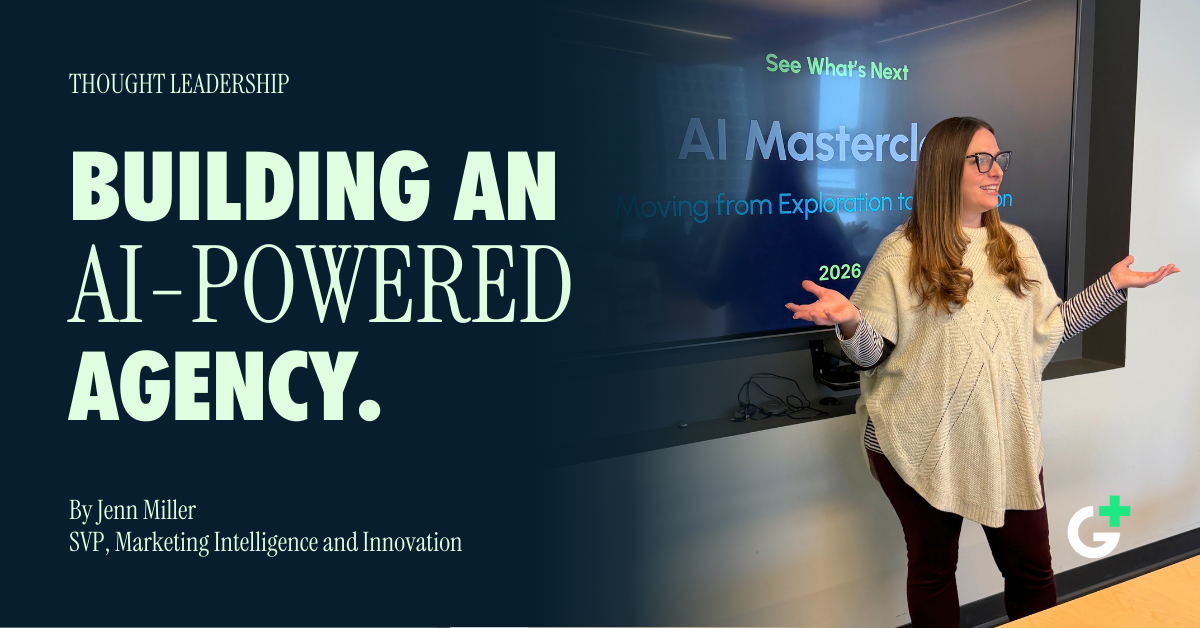
Our agency had a defining year in 2025. Not only did we officially expand to recognize our innovation capabilities, but we continued a cultural shift that began well before that, as I led the team through the stages of AI awareness and adoption.
In 2024, we were aware of AI and using it sporadically. However, we had a wake-up call toward the back half of the year: we were approaching this too casually. To truly harness this technology, we needed a structured environment, clear policies and a dedicated engine for growth. We set ambitious goals for 2025: building secure environments, publishing agency-wide best practices and reinstating an AI Committee charged with driving agency-wide literacy.
During Q1, we moved from planning to action, culminating in the launch of AI Month in April. This was a full-agency initiative designed to transform casual curiosity into tangible capability across every department. Led by our AI Committee, the month featured a structured weekly learning agenda and live "learning labs" that moved beyond theory into hands-on experimentation. This focused effort led to a 35% increase in AI usage in just one month, with every employee challenged to develop their own custom GPT to present to the agency the following quarter.
Throughout the remainder of the year, we put those learnings into practice with significant success. Then, in Q3 and Q4, we took a step back to recalibrate. Because nothing moves faster than AI, we realized we can never rest on yesterday's expertise. This reflection is what led us to redefine what it truly means to be "AI First."
Shifting from Ad-Hoc Prompts to Repeatable Systems
The foundational principle of an "AI First" company is treating artificial intelligence as a core business component rather than an optional feature or add-on. This requires a profound mindset shift away from reactive, ad-hoc usage.
- Incorrect Mindset: Simply asking, "Can ChatGPT help here?" This frames AI as an afterthought or a quick fix for an isolated task.
- Correct Mindset: Proactively asking, "What can we automate, accelerate or improve quality using AI?" This positions AI as a strategic lever for systemic improvement. You aren't just solving a task; you are rethinking the approach.
The shift is nuanced, but the impact is massive:

In essence, AI-first companies build systems, not just prompts. They prioritize a collective knowledge base where individuals and AI can operate without reinventing the wheel.
Moving from Siloed Experts to a Centralized Brain
In the "AI Experimentation" phase, knowledge stays in individuals' heads. A few power users might develop clever prompts, but this expertise remains siloed and inconsistent, with AI used mainly for speed. The leap to "AI Integration" happens when that knowledge is captured and codified into reusable systems, evolving the use of AI to deliver not just speed, but also quality and differentiation.
A powerful example of this principle is the concept of a central “Agency Brain.” The concept is to codify your collective knowledge to create a repeatable intelligence system that ensures consistent, fast and safe results across teams. The key components of this central brain include:
- A Library of Playbooks: Reusable prompt patterns and SOPs.
- Context Packets: Various guidelines and deliverable templates.
- The Learning Loop: Experiment logs and lessons learned.
- The Safety Net: Guardrails and QA checklists.
By externalizing intelligence into a shared asset, we create an operational backbone that scales.
Elevating Human Roles from Doers to Directors
A common fear is that a mature AI strategy makes human roles obsolete. The reality is the opposite: as AI handles the routine cognitive load, the value of human judgment and strategic thinking skyrockets.
Reflecting on my own 20-year journey, I realized my role has evolved from "Gatekeeper" to "System Builder."
In 2006, I was a Data Gatekeeper. I delivered numbers. When executives had questions, I was the one who retrieved the answer. My craft was SAS and SQL; I spent hours debugging code and hunting syntax errors just to extract data. Excel was my factory: a manual process of slicing and dicing to find a hunch. My deliverables were static reports and PowerPoint decks.
In 2026, I am an Insight System Builder. I am no longer the gatekeeper, but rather the steward of data access and reliability. My deliverable is an Insight System that allows users to interact with data in natural language to find their own answers. AI is now my factory: it’s where I brainstorm, analyze and build.
And this shift is not because of my 20 years experience. It’s the reality of the expectation set for the same role just 20 years later.
Our New Identity: We Do Not Rely on AI; We Discern.
An AI-first culture elevates people into strategic partnership with technology. We’ve identified five critical functions for the modern professional:
- The Experts: Codifying how we work into reusable playbooks.
- The Problem Framers: Defining the right challenge and selecting the right method.
- The Context Stewards: Maintaining the critical nuances that power great AI outputs.
- The Discerning Validators: Auditing accuracy, reliability and bias.
- The Creative Amplifiers: Elevating AI drafts into resonant, human-centric creative.
This reframes the relationship as a strategic partnership. Humans provide the essential direction, context and discernment, while AI provides the scale and speed.
How does your organization stack up?
A true strategic assessment goes beyond observing tool usage. Ask your leadership team these four questions to reveal where you truly stand:
- The Tool Test: If you changed tools tomorrow (for example, moved from ChatGPT to Claude), would you still be AI-first?
- The Verdict: If you lose your "smarts" when the tool changes, you have a software subscription, not a strategy.
- The New Hire Test: Can a new hire produce work the "Agency Way" without sitting next to a senior for a month?
- The Verdict: If you require a senior’s proximity to maintain quality, your expertise is lore, not a scalable asset.
- The Consistency Test: If three different teams used AI on the same brief, would the outputs be consistently on-brand and client-ready?
- The Verdict: If the quality depends on who is prompting, you lack the standardized context systems required for professional scale.
- The Compounding Test: Are you getting better at AI every month, or are you relearning the same lessons over and over?
- The Verdict: If your team isn't building on past discoveries, you are stuck in a loop of experimentation without evolution.
I have to admit, the Tool Test struck me the hardest. We realized we were heavily dependent on specific custom GPTs. If those vanished, so did a portion of our "smarts." That realization is what pushed us to build a more resilient, tool-agnostic backbone.
The Real Question Isn't “If,” but “How"
Becoming "AI First" is not a technology purchase; it is a profound operational and cultural shift. It marks the difference between being a casual user of AI and becoming an organization fundamentally powered by it.
As AI becomes table stakes, the ultimate question for every leader is no longer if they will use it, but: How will we evolve? At our agency, we’ve made our choice. We aren't simply using AI. We are building the future on AI.