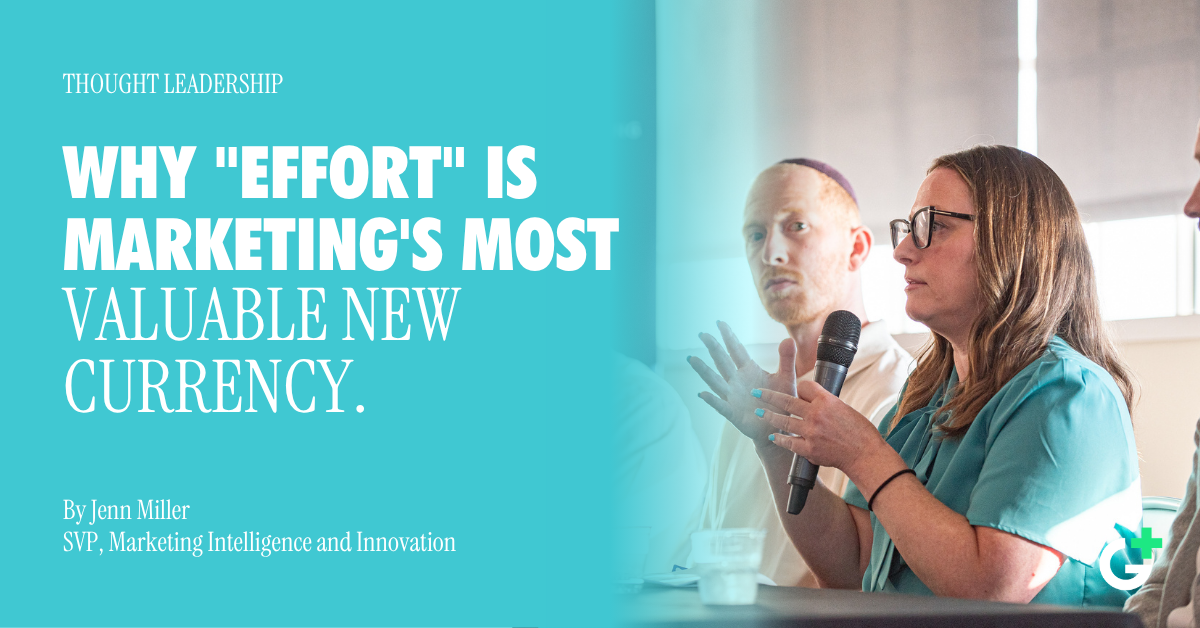
I had the opportunity to speak on the recent AI in Action panel hosted by the American Marketing Association Pittsburgh chapter and Media Association Pittsburgh earlier this month. I was honored to share my perspectives on what Gatesman is doing in the AI space, while also reflecting on the incredible insights shared by my fellow panelists.
The primary purpose of the panel was to move past the broad headlines and explore exactly how marketing professionals are practically applying AI in their day-to-day operations. Instead of just running through an agenda of real-world use cases and adoption challenges, the conversation ultimately centered on a much bigger theme: how AI is fundamentally reshaping team workflows without replacing the essential human element in marketing. I highlighted several key use cases that Gatesman is using today, many of which sparked some profound "aha" moments that I want to share.
The Death of the Passive Dashboard
Historically, the analytics process involved digging through filters and reports to find data that an analyst would translate into insights. This would involve going to dashboards, waiting for reports or getting into the analyst queue to get an answer to a question.
Today, the average business user has a whole new expectation – they expect fast answers to plain-English questions. This means the traditional passive dashboard is no longer meeting the needs of most marketers.
To counter that shift, Gatesman is moving toward building intelligent agents directly into data ecosystems. Instead of relying solely on dashboards, we are building full environments where AI proactively alerts marketers to changes and allows them to talk directly to their data. It includes dashboards as just one option within this ecosystem.
The warning for businesses who want this type of system is that AI is only as good as the underlying data. You need to store context on the business, campaigns, audiences, metrics and changes over time or AI will provide misleading answers. Preparing the data remains the most difficult part of the process. Luckily for Gatesman, we’ve been building the backend system to support this very need for years.
Generative Engine Optimization (GEO) and the Future of Discovery
With the introduction of chat-based AI, we have seen a huge shift in expectations among both marketers and consumers. Nearly half of U.S. online shoppers are incorporating AI into their purchase journeys, asking tools like ChatGPT or Gemini what to buy instead of using traditional search.
Generative Engine Optimization is the evolution of SEO for the AI era. It requires a stronger focus on structured data, natural language and authoritative content. But AI also relies heavily on PR, reviews and social credibility as signals of authority when deciding which brands to recommend. Gatesman has been helping clients navigate this trend by amplifying their technical GEO and building their trust.
One audience member asked about the future of websites. My belief is that despite AI agents communicating directly with users, brand websites will not disappear. They remain a crucial requirement for housing the relevant content that feeds LLMs and search engines. What’s not yet clear is what the website will become. I suspect this is where evolution will occur the most.
Connecting Workflows, Not Just Tasks
Two years ago, AI assisted with individual, isolated tasks. Today, it connects entire workflows from research to deliverables. When asked about the evolution of AI, the entire panel reiterated different ways that they are incorporating this connectivity in their daily work.
For my team, tools like Google's Antigravity, Claude Code and Codex are accelerating the development of our data pipelines. This AI-assisted coding significantly speeds up testing and debugging to ensure that we have the AI-ready data available to support the new intelligence ecosystems and conversational analytics.
Each panelist shared similar efficiency use cases including deep-dive research and learning, the ease of starting a new project without a blank canvas, simplifying complex knowledge and making that more accessible, and creating proof of concept that help tell your story.
One thing is for sure: No matter how much more efficient you can get, the panel agreed that AI is not just a tool or software purchase to an organization, nor is it an opportunity to reduce headcount. It’s a method to actually do more with less, which is what businesses have been demanding of their marketers for quite some time now.
The "Aha" Moment: Effort as the New Currency
What caught my attention during the panel was a new notion that I hadn’t yet considered – the idea of “Effort as a Currency.”
Humans still value humans because while AI can imitate, it cannot replace lived experiences, personality and authentic connections. We see this especially in certain types of work, like video production or high-quality art. AI can generate these assets in seconds, but it lacks the human touch that makes them resonate.
I started thinking about how we could use this concept and intentionally make an effort to show we care. Yes, this can be done by the brand towards customers by putting emphasis on key experiences or with certain ads. But it can also be used internally with clients, prospects and peers. When we put forth any kind of work for a big meeting, pitch or something that’s important to us, we can show an extra layer of intentional care by doing things for ourselves instead of turning to AI.
The Hidden Cost of the AI Horizon
As we closed out the panel, we were asked to consider where AI will be in three years. “Three years is a long time,” remarked one panelist, and I couldn’t agree more. Nonetheless, a common consensus emerged: AI will eventually become invisible. It will just be something we do, rather than something we constantly talk about.
Another thought I shared, which resonated with the audience, was that we need to get much more intentional with how we use AI. Today, AI feels somewhat commoditized, with much of it available for free. I don’t think this will always be the case. When we use certain AI features, we are consuming tokens, a new currency we are still learning to translate. On top of that, the AI industry will eventually need to make money.
I was recently reminded of a study I helped publish long ago. We surveyed users scheduling jobs on a supercomputer to see if they could accurately estimate the resources or timing their jobs needed. The answer was a resounding no; it just wasn’t possible. I suspect today’s AI users are in a similar boat. It is incredibly difficult to balance the amount of context provided and "pre-think" everything needed to reduce resource consumption. But in three years, this will become central to how we use AI, as we will be navigating a new reality of consumption-based pay.
Redesigning Your Role, Not Protecting It
I will leave you with one final question from the panel: “If someone on your team says, ‘I'm worried AI is going to replace my job,’ how do you respond?”
My response is that AI will absolutely change your job, but it will not replace the marketer. The goal for professionals is to redefine your future roles by adapting alongside AI. It is up to you to take the power back and shift your mindset today so you are no longer worried about AI, but actively befriending it.
.jpg)