THE GIST
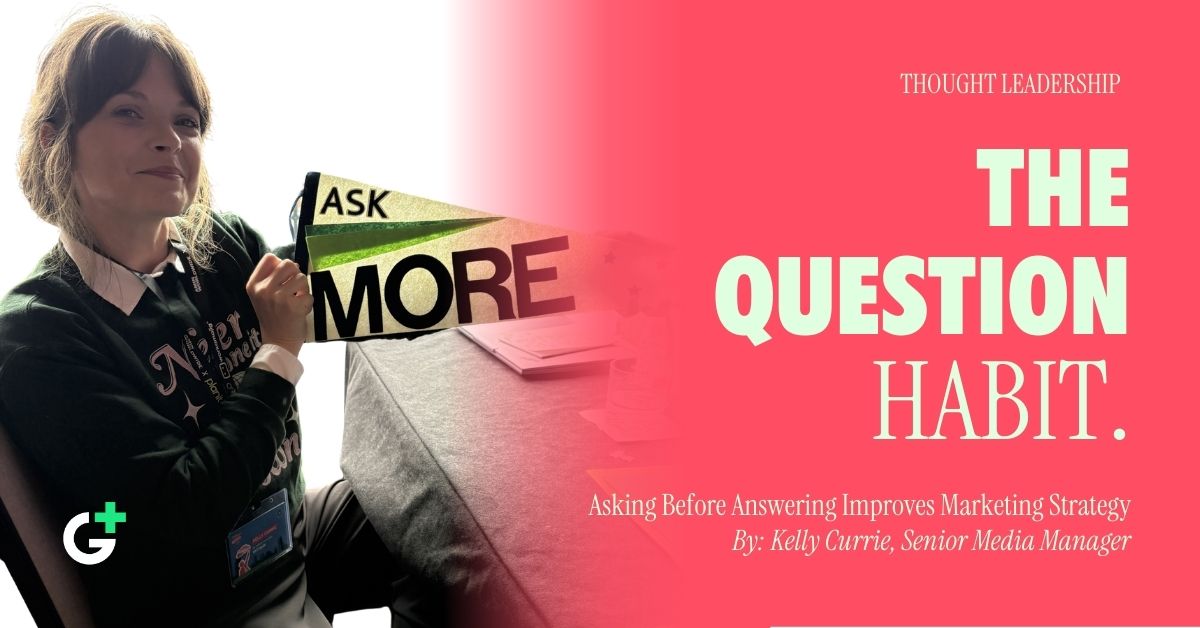
The most underrated skill in modern marketing isn’t a hack. It’s a habit. This is your 2026 reminder to work with people who hone what we call, “THE QUESTION HABIT.”
In a world obsessed with speed, the marketing teams and partners who consistently deliver impact are the ones who know when to pause and ask questions, so that you can make smart and innovative decisions the first time around.
Example:
Question: Can you build a resource hub for us?
Answer-first response: “Yes, we’ll build it.”
Question-first response: “Sounds interesting! What are we trying to solve?”
THE RELATABLE CURRENT STATE
Marketing teams are under more pressure than ever to move fast, be right AND prove impact.
Clients have questions. Leadership wants certainty. Budgets are limited. Time is tight.
And somewhere in the middle of all of that, an unintended shift has happened. The industry has started to reward speed over understanding—not because they don’t care, but because the pace of modern marketing subtly teaches us that asking too many questions appears as friction.
I’d argue the opposite.
WHY IT’S A PROBLEM
If you hesitate, ask for more context or suggest we pause and explore, it can feel like you’re underdelivering or slowing things down.
The teams doing the strongest work right now aren’t the ones with the fastest answers. They’re the ones with the best questions. The one’s widening the lens before liftoff.
But what’s at risk if we don’t pause to ask, explore and assess before moving forward confidently? What if we execute exactly what was asked for, but not always what is needed? The result is not always bad work, but it is narrow work. And narrow work…
- struggles in a landscape where audience behavior, platforms and signals are changing fast,
- and is costly in terms of rework, misalignment and decisions that feel harder to defend later.
THE SOLUTION: CURIOSITY
Don’t sleep on curiosity. Encourage it. Bake it in. Reward it. Most importantly, create—and defend—space for it within your teams, partners, and your marketing strategy framework.
People tend to talk about curiosity like it’s a personality trait or a “soft skill.” But the data tells a different story.
Teams that practice continuous questioning outperform answer-only teams by 25% in innovation metrics, and 80% of executives say curiosity and flexibility are critical for adapting to AI-enabled work (Leadership IQ).
These moments of exploration don’t reduce momentum.
They help focus it.
WHY NOT EVERY AGENCY PARTNER DOES IT
Pausing, however, can look a lot like hesitation. Asking questions can feel like friction, especially in environments where confidence can be mistaken for immediacy.
But that pressure to answer fast rather than well can quietly narrow thinking, leading teams toward only familiar approaches.
You didn’t hire an agency to simply agree. You hired them to think.
So instead of reacting immediately, we take the time to ask ourselves and our clients:
- “What problem are we hoping this solves?”
- “What’s changed since the last time this worked correctly?”
- "Where in the process are we running into problems?"
Much like taking a breath before responding in a critical conversation, this pause protects momentum rather than slowing it, leading to:
- Fewer surprises in later stages
- Clearer alignment across internal stakeholders
- Decisions that hold up better when performance is reviewed later
HOW WE WORK IN STRATEGIC QUESTIONS
We’ve been leaning on lightweight structures to make curiosity actionable, not abstract, in both internal and external collaborations.
One such structure that we lean on is “The C.A.S.E. Framework.”
- Clarify the request
- Assess the current state
- Surface assumptions and constraints
- Expand what’s possible
This framework typically helps at the beginning of a project, but we also lean on it when one-off requests or new campaign opportunities come up.
WHERE WE’VE SEEN IT WORK
At Gatesman, we’ve seen this approach strengthen partnerships across B2B and national brands alike. We recently saw this play out in real client work with our friends at USG.
What started as a straightforward request to develop a multichannel campaign became something more once we took the time to ask a few additional questions about their audiences. By leaning into the opportunity rather than just fulfilling the ask, we were able to “yes-and” the opportunity into a connection point between USG and their target market, resulting in a 200% lift in engagement.
A seemingly simple request opens the door to a more effective solution once the right questions are on the table.
This is just one example of where we’ve seen strong partnerships make a difference.
It’s not just about execution. It’s about judgment and having a partner who can help you make sense of ambiguity, pressure-test assumptions and move forward with confidence when the path isn’t immediately obvious. That’s how you move fast and stand behind the choices you make.
Curiosity isn’t a soft skill in that relationship.
It’s a strategic capability.
The right partner doesn’t just respond quickly.
They help you move forward confidently.
TAKEAWAYS
So, to emerging marketers:
- Release the pressure to have all the answers in the moment
- Recognize that our industry sees curiosity as a skill
- Get habitually more comfortable with asking good questions
- Note what it unlocks and brings into view
To CMOs and brand marketing teams:
- Pick an agency partner with strong judgment who helps you think things through and asks the right questions before committing to answers. It should feel like a signal that your partner takes your outcomes seriously.
- Remember that when agencies protect time to assess before answering, you are empowered with decisions that are easier to explain and support later.
About Gatesman:
With offices in Pittsburgh and Chicago, Gatesman is a full-service agency offering expertise in strategy/branding, advertising, public relations, social media, digital and analytics. Gatesman is a partner in AMIN Worldwide, an alliance of over 50 independent marketing agencies, IPREX, a global communications network, and most recently the Ad Age Small Agency Network. Gatesman acquired Quest Fore in 2014 and Noble Communications in 2017.
# # #
.png)